
Heat pump installation: process and scope of costs
Checked
A good installation starts with a survey and a design for your house. Site preparation, connection, testing and commissioning follow.
“Basic installation” has no standard scope. Before ordering, ask for an itemised breakdown of materials, electrical work, building work and commissioning. A fixed price or installation time cannot be set without knowing the house.
What to prepare for the survey
The installer needs to know how much heat the house needs and what water temperature the radiators or underfloor heating require. Floor area alone is not enough to choose the output. The design should also take account of hot-water production and any planned insulation (SIEA).
If you do not have some of this information, ask for the quotation to state who will provide it. An estimate of annual consumption does not replace the house's design heat loss.
How installation works
Survey and design
A designer or installer assesses the heat demand, the heating system and the space for equipment. The result should be a specific system and scope of work.
Agree the price and preparation
Set out in writing what you will prepare and what the installer will do: foundation, wall penetrations, power supply, drainage and removal of the old heat source. Agree dates and any period without heating.
Positioning and connection
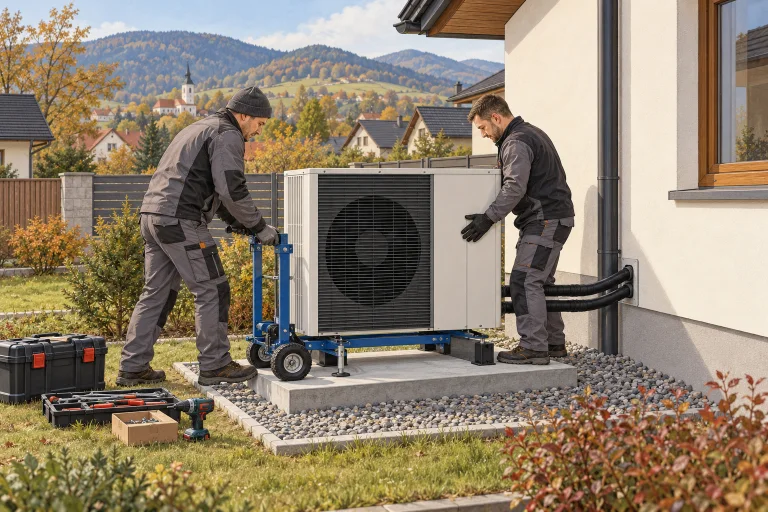
Qualified installers fit the units and connect the heating system and electricity according to the design and the exact model's manual. Clearances, frost protection and condensate drainage depend on the equipment and the site.
Testing and commissioning
The installer checks the connections and operating conditions and sets up the controls and heating curve. The tests and required inspections must match the work carried out.
Handover and instruction
Go through the controls, what happens in a fault and the service contact. Collect the records, manuals, warranty conditions and documents for the work done.
Who may carry out each part of the work
Ask for the quotation to name who is responsible for the heating system, electrical work, the refrigerant circuit and commissioning. Ask the installer for qualifications covering the work they will actually do, and for confirmation of the manufacturer's warranty conditions.
A split system also involves connecting refrigerant pipework. A monobloc has its refrigerant circuit in the outdoor unit, but still needs a proper design and qualified connection. So do not judge an installation only by whether the firm appears on the subsidy list.
Design, permissions and local conditions
Under section 18(5)(i) of the Slovak Building Act, equipment producing heat from renewable sources up to and including 50 kW needs neither a building-intention decision nor a notification. This rule on its own does not cover every related piece of building work.
Boreholes, wells, use of groundwater or a protected area need the relevant procedures checked separately. Before ordering, have the designer set out which documents and statements your particular installation needs.
Hydraulics, electricity and positioning
The design should deal with heating-water flow, any cylinder, filtration and frost protection. An electrician assesses the supply, protection and any changes to the consumer unit. Positioning must take account of airflow, service access, noise and condensate.
For example, the Vaillant manual 0020326638_04 (PDF) covers these requirements for specific models. Its dimensions and protective areas cannot be transferred to another heat pump.
What the quotation should include
Ask the installer to mark each item as included, extra or excluded. Compare quotations with the same scope, not just by the bottom line.
Extra installation charges and servicing
These are individual price-list examples, not the price of a whole installation or a market average. Do not add an item again if your package already includes it.
| Work | Price | Note and source |
|---|---|---|
| Concrete foundation for the outdoor unit | €250per job, excluding VAT | Indicative regional offer.NašaKlíma, checked 20 October 2026 |
| Buffer-vessel installation | from €150per job, excluding VAT | Starting price from a regional offer.NašaKlíma, checked 20 October 2026 |
| Heat-pump commissioning | €307.50per job, including VAT | Price subject to a survey, rather than a fixed offer.NPE, checked 20 October 2026 |
A new electrical supply, consumer-unit changes, ground works and adapting the old heating need pricing separately. The price for connecting to a prepared supply is not the price of all the electrical work.
| Service | Price | Note and source |
|---|---|---|
| Standard service up to 10 kW | €129including VAT | Travel and parts may be excluded.CELSIO, checked 20 October 2026 |
Confirm the service conditions and scope for your own model. A routine service inspection, an electrical inspection and a refrigerant leak check are different services.
Price lists checked 20 October 2026. Suppliers may change their prices or scope; your own quotation is what binds.
Common questions
Does every heat pump need building permission?
No. The equipment itself is covered by the exemption described in the section on permissions. The assessment must still include related work and any borehole or wells.
What should the handover record contain?
As a practical checklist, ask for identification of the system, the date and the responsible person, the tests carried out, the main settings and any outstanding work. Also collect the manual, warranty documents and relevant inspection reports. The manufacturer and the work carried out determine the specific form and scope.
What is often outside basic installation?
A foundation, longer pipe runs, wall penetrations, a new electrical supply, removal of old equipment and changes to the old heating are often priced separately. This is not a universal list of exclusions: the specific installer's written quotation decides.
Sources
We are an independent information site. We do not sell or install equipment. These dated sources do not replace a design for your home. Source links are not affiliate links.
- SIEA: choosing a heat pump (Slovak) — system design and conditions for efficient operation
- Slovak Building Act 25/2025, section 18 — version in force from 1 November 2025 to 31 December 2026
- Vaillant: manual 0020326638_04 (PDF) — example requirements for VWL 105/6 and 125/6 A; not a universal installation manual
- NPE: commissioning — scope of the service and documents handed over; price after a survey
- NašaKlíma: installation work — individual price examples excluding VAT
- CELSIO: service price list — a separate service inspection