
How to choose a heat pump: type, capacity and comparison
Checked
Check the house, heating emitters and available heat source first. Then choose the exact system for winter output, required water temperature, modulation, placement and service. The brand is only one of several later considerations.
House and heat-source data
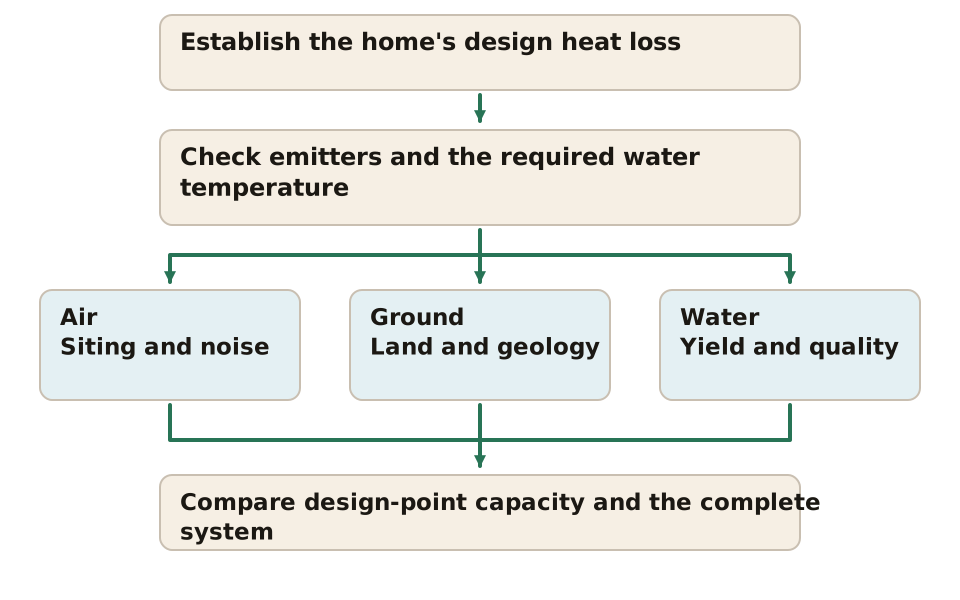
Air-source needs outdoor space and an acoustic assessment. Ground-source needs land and a designed borehole or collector. Water-source depends on proven water and lawful handling of it. The scope of work and the risks differ for each option.
Output at the design point, and modulation
Ask for room-by-room heat loss and the heat pump's output at the local winter temperature and the actual heating-water temperature. The number in a model name may not describe that operating point.
Modulation is the ability to adapt output to demand. An oversized unit may start and stop frequently when demand is low, so minimum output and the control design matter too. A higher nominal rating is not automatically the safer choice.
Heat loss, local climate and radiators
Age, floor area and the annual bill do not establish design output on their own. Check the fabric, ventilation, desired temperatures and planned renovation. A regional climate table and historical records are not automatic inputs for a particular plot.
For radiators, compare their output at a lower water temperature with each room's heat loss. The maximum temperature in a brochure does not replace winter output or efficiency data.
Comparing types and brands
Heat-pump types
- Air-to-water
- Takes heat from outdoor air and heats water for radiators or underfloor heating, as well as domestic hot water.
- Air-to-air
- Heats and cools rooms through wall-mounted indoor units, like air conditioning. It does not heat water.
- Ground-source
- Extracts heat from the ground through a borehole or garden collector. Ground works make up a substantial part of the cost.
- Water-source
- Extracts heat from groundwater in wells. It needs enough suitable water and the relevant permissions.
When comparing brands, compare the exact indoor and outdoor model codes, generation, electrical variant, climate zone and test conditions. A compressor warranty, a materials warranty and a warranty on all the work are different things.
- Daikin heat pumps: models, specifications and conditions
- Vaillant heat pumps: models, specifications and conditions
- Mitsubishi Electric heat pumps: models, specifications and conditions
- Samsung heat pumps: models, specifications and conditions
- Midea heat pumps: models, specifications and conditions
- Buderus heat pumps: models, specifications and conditions
- NIBE heat pumps: models, specifications and conditions
- Panasonic heat pumps: models, specifications and conditions
- IVT heat pumps: models, specifications and conditions
The order of these links is not a quality rating, and the brands are not partners of this site. Missing conditions or prices are not zero.
Checklist for the design and quotation
Common questions
Is 8 or 12 kW enough?
Compare the house's heat loss with the winter output available at the required water temperature. Floor area alone cannot answer it.
What if the unit is too large?
Check minimum output, cycling and controls. An unnecessarily large unit may not run economically.
When does a hybrid make sense?
When the design justifies working with another heat source and includes its energy and fixed costs. It is not a universal rescue for an unsuitable design.
Sources
We are an independent information site. We do not sell or install equipment. These dated sources do not replace a design for your home. Source links are not affiliate links.
- SIEA: choosing a heat pump (Slovak)
- ÚNMS: STN EN 12831-1 — The catalogue confirms the standard's scope; it does not replace a calculation.