
Heat pump connections: circuits and conceptual diagrams
Checked
A diagram explains where heat travels, but it does not determine the correct flow rate, cylinder, cabling or circuit protection. The connections must suit the heat pump, the emitters and the controls of the particular house.
The following diagrams explain how the system works. They are not instructions for a do-it-yourself installation.
What runs between the units
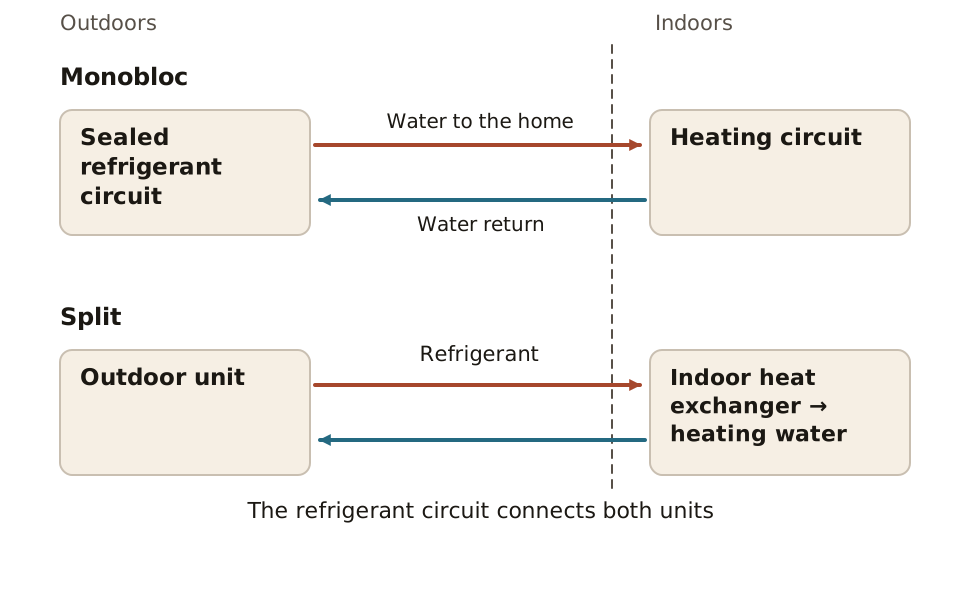
A monobloc also needs a way to protect the fluid outdoors during a power cut. A refrigerant split needs a professional connection of the refrigerant circuit. Neither design removes the need for hydraulic and electrical design.
The heating circuit and hot water
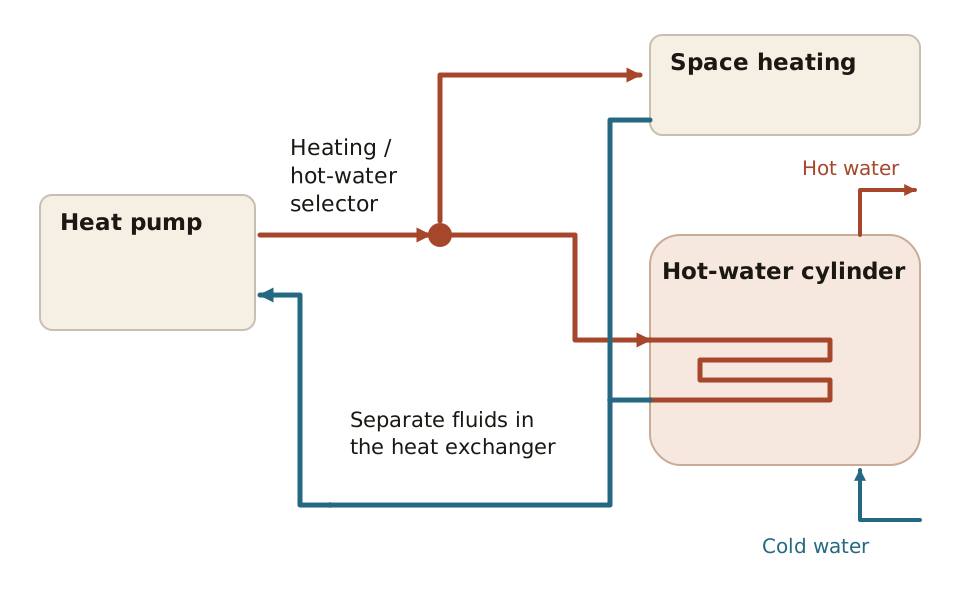
Flow and return pipes connect the heat source to the emitters. Heating water in a cylinder has its own requirements for the heat exchanger and priority control. The expansion vessel, safety components, air venting and dirt protection each have a specific function, not just a line in the budget.
Why flow and water volume matter
Closing zone valves must not break the heat pump's minimum operating conditions. During defrosting and backup heating, the requirements can differ from normal operation.
A specific example: for Daikin EHBH/X04+08EA/EJ6V+9W, manual 4P629081-1A · 2020.08, section 5.2.1 states at least 10 l of water outside the unit's internal volume and a required flow of 12 l/min during defrosting or backup heating. These are not universal values for every heat pump.
A buffer vessel or a bypass can be part of the solution. The design determines whether they are needed and how they are connected; the example does not mean every house needs the same vessel.
Backup heating and controls
The controls should coordinate the heat pump, emitters, hot-water heating and a second heat source. With an existing boiler, define when it runs and which valves and protection are needed. The backup's share also belongs in the annual consumption estimate.
Checks before installation
Do not choose the circuit breaker or cable size from the nominal heat output in kW. The electrician works from the electrical data, installation conditions and the requirements of the specific equipment.
Common questions
Is a buffer vessel always necessary?
Not as a universal rule. The design must show that the operating conditions are met in the particular system.
Why is radiator output not enough?
The heat also has to be delivered. Insufficient flow or unsuitable control can prevent correct operation.
Can I keep my boiler?
Yes, if the two sources are designed and controlled to work together. It is not just a matter of connecting both to the same pipes.
Sources
We are an independent information site. We do not sell or install equipment. These dated sources do not replace a design for your home. Source links are not affiliate links.
- Vaillant 0020326638_04 — Exact /6 variants; frost protection and hydraulics.
- Daikin 4P629081-1A · 2020.08 — Section 5.2.1 and commissioning; listed variants only.
- SIEA: how the system works (Slovak)